Far Nybei
The isolated continent, far to the east of Essen Revir and far to the west of Ilium Aghor. Nybei has five distinct regions which have long histories of intermittent allegiance and warfare. The legends of Nybei are old, with many of its lands being first settled in the dawning of the first age - particularly the legendary High Kaiden. The continent is commonly seen as exceedingly distant, and its geopolitical status is generally ignored by the Great Kingdoms of the world.
Leina, a village in the lower Nasani region, sits on the Crystal River under a clear sky.
Beginning from the North, Kanta Masa is a fertile, lush lowland with windy coasts and arable farmland. Its bordering waters are dotted with an archipelago called the Nine Isles, where there exist centuries old sea-villages of modest farmers and sailors. Kanta Masa, though it is a relatively peaceful coastal countryside, has been the victim of vicious ocean disasters. Historically, Kanta Masa was one of the hardest hit by the Flooding, a catastrophic tsunami event that also decimated other coasts of Hesk and Essen Revir. Away from the coast, inland, lie great swaths of farmland, generating huge amounts of rice, potatoes, root vegetables, sugar, and textiles, all of which are also used for export to the south. Kanta Masa does not have a centralized government, rather its villages are represented by elders that regularly hold representative council in the sole city of Nasan.
The states of Jai Se begin south of Xinxe's Divide, a mountain range with one high-traffic highway running through, known for its clogged border, militarized by both north and south countries. The country of Jai Se is made up of twelve individual states that have their own laws and strictures. The higher level of structured government and drawn political borders of Jai Se lies in stark contrast to the relaxed, liberal nature of Kanta Masa. Historically, this has caused many cultural differences which lead to disputes and conflict between the two regions. Jai Se is largely temperate, with many rivers cutting through the land providing fertile farmgrounds. Quarries in the country provide a lucrative industry of stonecutting and masonry for architecture, and very importantly, salt however, this also has led to the enslavement of weaker states - causing bitter hatred between borders, or the lesser states' total annexation. States such as Hujin and Fou have opulent, sprawling palace cities built for their Lords, while the people of Wan are objectified and live in shambling, resource-starved "dirt-cities".
Old ruins of the ceremonial grounds beneath Ganto quarry, are still preserved and respected by the Fou nobility.
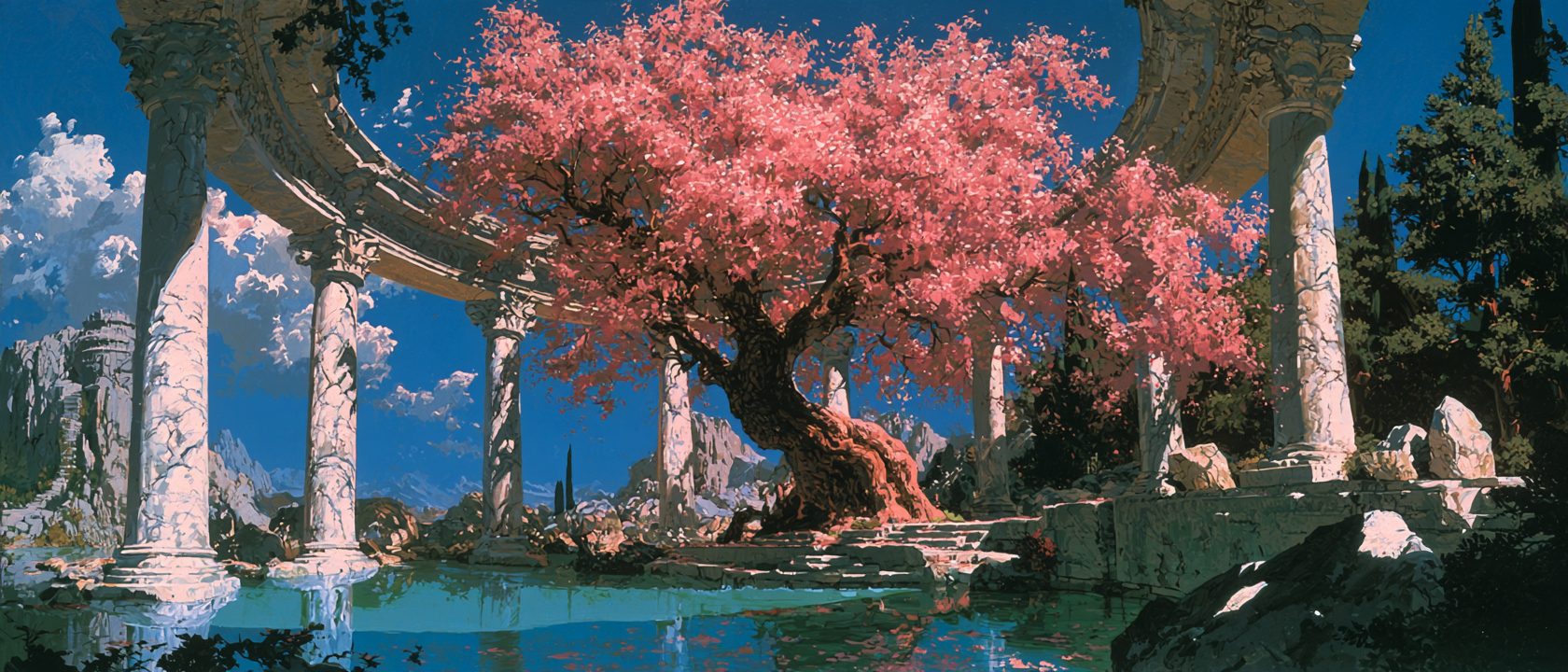
South of Jai Se, beyond the Great Bell Valley, rises the jagged lands of Ai Ishi. Many believe Ai Ishi to have been created by the Painter Gods, a pantheon unique to the region that explains the way the valleys carve through the region, overgrown with trees and vegetation bright in color, as a painters' palette. The lowest point in the land, far below sea level but bordered by hills and hanging forests, is Shune's Basin. A well-guarded, holy site to many Ishin in reverence, and named after Shune, Goddess of Laments. Many other points of interest are named after her, marking her importance to the Ishin people - also showcasing an interesting dichotomy between the melancholic, sorrowful nature of the goddess with the vibrant, bountiful landscape that she represents. Ishin live in large villages and small cities that dot the varied region. They mostly subsist of sweet diets, high in fruit due to its abundance throughout. Pinpins, nuri, cherries, kakano, and pinkberries are all extensively farmed and enjoyed, and are traded with the rich merchants of Jai Se during the annual ringing-of-the-bells.
The farthest south of Ai Ishi begins to drastically ascend in elevation, the high hills becoming a great mountain range known as the Cloud Pearl mountains - named so because of the light that bounces off of the pink blossoms, ever-coloring low-hanging clouds. Beyond the Cloud Pearls rises High Kaiden - the oldest and strongest region of Nybei by far. Kaiden, existent since the first era, has seen countless lords and armies rise and fall upon its bloodied lands. It has been the site of storied wars and conflicts and beset by great curses and disaster - and has overcome them all. The most notable conflict being that of the Cursed Army of Balos that rose out of the underworld to conquer all of Nybei. The Legion of Kaiden led the five nations, united as one, to defeat the horrific enemy.
The current standing ruler of Kaiden is the Great Shogura Isai IV. Its culture is broken down into strict status categorizations, with municipalities being governed by tiers of lords. The civilianry of Kaiden are generally lawful and orderly, however the historical strife of the land can lead to strained relations and trouble amongst sub-cultural groups within the nation. Trade throughout the land is entirely self-sufficient, as the roads to Ai Ishi and San Zai are much too difficult and long for reasonable mercantile. Textiles, food and architecture all come from within Kaiden.
The southernmost nation, San Zai, begins past the massive Sheso Cliffs, a sheer mountainside that is the steepest drop in the entire world. From Kaiden's edge, it is a rarity to be able to see the lands of San Zai below, as it is normally obscured by the same low-hanging clouds that fill the Cloud Pearls. Built into the side of the cliff face is the extraordinary Great Lift of Sheso, a mechanical marvel said to have been designed by the illustrious ruler of the same name. Its construction began in the middle of the third era but was stopped during the Minh Uprising of III-1708 when Lord Sheso was assassinated. It did not resume until III-1870 when King Totore I came to power with the goal of reconstruction and revitalization of the nation, and was completed by III-1939 by his son, Totore II.
Sheso's Monasterium, a place of disciplinary soul rehabilitation, is built into the jagged glaciers of San Zai.
As you head further toward the southern coast, the snows begin to gain fervor, and the lands become pale with frost. The waters around San Zai are horribly tumultuous, and often icy, making sea travel a near impossibility. Thus, the people are resilient, hardened by their isolated nature. Like Kaiden, all agricultural production comes from within. San Zai manufactures a frost-resistant, cotton-like substance called bari-bari that is used for both textiles and nutritious food. Bari-bari is often used in clothing, rope, for adhesive, as well as in a variety of dishes alongside rice and green vegetables.