The Tale of the Ghostly Wanderer
We were of the K’bas, a small folk that dwelt along the Oluine river, and we kept to the heart of the Glaurfeldt whiles the holy king Mano kept his vigil against the dark. In those days was he a devout lord, beloved of God, and his knights held the borders of the under-realm whene’er the shadow came against them. None of us thought ill of him. When his daughter Filibeth wandered into our wood as a child, we deemed her but lost.
She was not lost. Deep in the K’bas stood a tree with pink leaves, which we worshipped, and the princess went unto it as though she had been called by name. Time ran slower beneath its boughs. Filibeth grew strange there, and full of power, aging scarce at all while the kingdom without went on without her, and in the long seasons of that wood she became somewhat like our own. Yet then she departed.

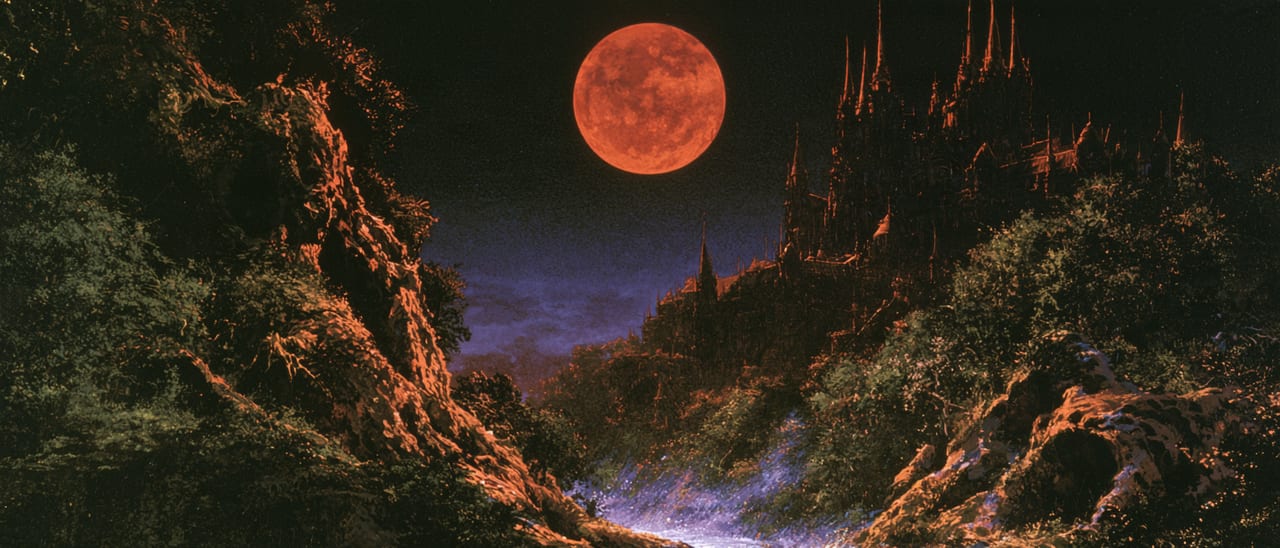
Princess Filibeth stands beneath the K'bas Godtree.
Of her father we knew only what the wood might see. One night the moon rose red over the Glaurfeldt and did not pale again, and men who had called Mano’s realm the Starry Kingdom ceased to call it so. The stars left the sky, for only the crimson glow remained. Not long after, Filibeth returned unto us, hunted, her mother’s name unspoken upon her lips, and she would not tell us from what she fled. She thickened the mist until no road led to the tree and no eye might find it, and for a long season the forest held and the flow of time slowed. She became our leader, an outsider beloved. The years without passed swifter than within the mist.
Then, in the summer of the four hundred and seventieth year of the Fourth Era, came the dragon. Heldranc he was named, last of the old dragonsblood. He flew above the king’s banners, and I know only what mine eyes beheld. Fire fell from the ill-moonlit sky, the mist boiled away, and the K’bas burned from the river to the hills. My kin died in the smoke, in the flames, or upon the blades of the soldiers as they fled. I lived because I fell among the dead and was taken for one of them, and was able to speak my way unto imprisonment.
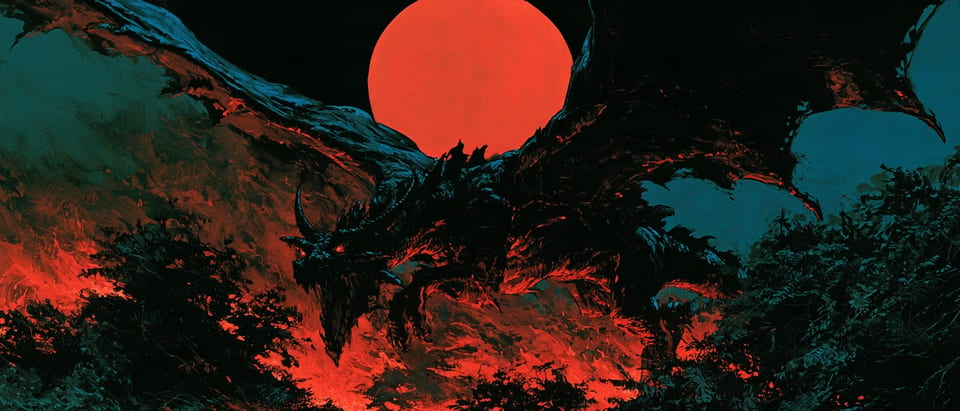
Heldranc burns the K'bas.
But ere I was taken, at the roots of the tree I saw the end of it. Mano came with his weapon—Glaidrogh, the great-axe of his house—and hewed down the ancient tree in a single stroke, then turned its edge upon his daughter. Yet there were strangers in the ash where no strangers had been: a priestess calm as still water, a ranger whose eyes met the dragon’s and looked not away, and others in the garb of no country I knew. With a flash an elderly wizard with glowing tattoos appeared, raised his staff, and the world stood still. Every ember hung in the air like a fallen star. He cast spell and sorcery upon the soldiers of Mano, and reduced them all to dust. The priestess ran to Filibeth, the axe of Mano frozen above her head, and drew her to safety. Through a green portal they all passed, and Filibeth passed through it with them and was gone. All but one, for the king’s axe found the tattooed magus ere he might release the spell for the others. Why a holy king would burn a holy wood beside a dragon, and lift his axe against his own blood, I never learned.
I was taken in chains to the dungeons of House Manos, and what was done to me there is not part of this tale. When at last I slipped my bonds, I swore upon the ash of my people that I would find where she was taken and those who carried her out of the fire, howsoever far that might be.
Hatred is a road, and mine led down it. Mano’s enemies were the Dark, and so I went unto the Dark. In the south, to the Darklands of Enthar where the Beckoning Bell still tolls, and where Vorn, the Dark Prince, keeps his congregation of whisperers. Pilgrims too venture from across the lands, swearing that they speak with the Living Dark that mutters from within. I brought him my grief and he gave me back a purpose. I heard the whispers also. They are real. I learned the names of the Disciples of the Void: Bel Harath of the Molnaran Inferno, Ito Gangara who rules below the leylines, Mintas Fae of the Everdark whose words etch themselves into the archroots, Vehem Adahr the Dreaming King of Uyin, and Vorn himself. I learned what they hunger for, and the Dark learned me in turn. I went deeper than any pilgrim should, and when I came back up I was no longer wholly a child of the wood.
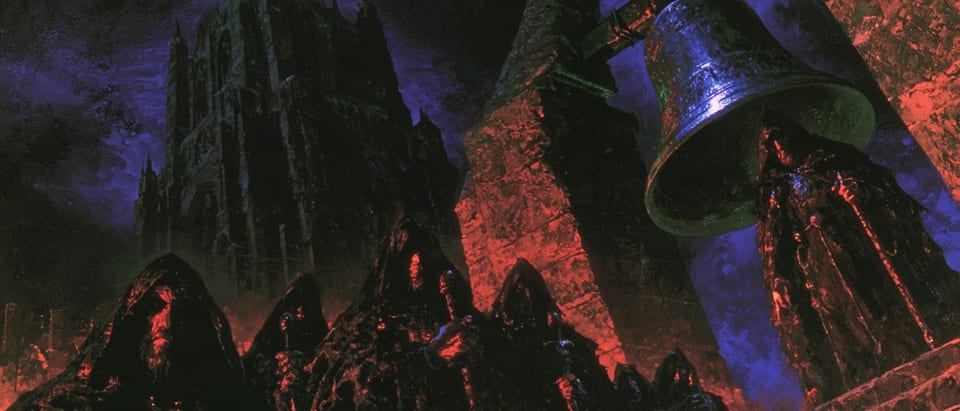
Vorn's dark congregation beckons supplicants forth.
Two thousand years is a long time to keep a vow, but the Dark taught me that time hath seams, and I found one. I crossed into the fifth era by great sorcery cast upon me, and now I walk in a future age where the K’bas is a song and the Glaurfeldt an even mightier and more formidable kingdom, for the king is not dead. Neither am I. Somewhere in this age, Filibeth still lives, and the ones who took her through that green door, and I have come to ask what they owe.